



.JPG)


|
|---|


Monday, February 21, 2011

Brush your long, grungy mop from your eyes, turn down the Nirvana and take a look around. It's the early '90s and an army of sport utility vehicles are flooding the streets. The newest four-wheeled object of America's affection has quickly become the default mode of transportation for everyone from inner city professionals to suburban soccer moms.
Fast forward a couple of decades and although sport utes are still around, they've largely been displaced by the crossover – the SUV's easier-to-maneuver, more fuel efficient and more comfortable unibody progeny. But even after years of refinement, the CUV is still a basketcase of compromises. Which begs the question: Did we have it right back in the day? Is a wagon still the best compromise of size, functionality and driving dynamics? We snagged the keys to a 2011 Acura TSX Sports Wagon to find out.
Needless to say, the TSX Sport Wagon is based on its sedan counterpart, but in addition to its two-box shape, Acura has set it off with a redesigned grille. The new piece looks far less hawk-nosed than the one worn by the four-door, as its been broken up by a thinner frame that creates a slimming effect. The lower bumper also improves front-end styling with a much wider and more aggressive appearance. Seeing the TSX Sport Wagon for the first time is a bit like running into that formerly plain-looking girl from high school who got some work done and now dates a pro baseball player; she looks nearly the same, but somehow better. And she knows it. All of which suggests that Acura's stylists may have been listening to at least some of the criticism they've received over the company's controversial front fascia.
The Sport Wagon's updated nose gives way to that long wagon body, which also benefits from a handful of well-placed styling elements. Noticeable fender bulges wrap around the 17-inch five-spoke aluminum wheels and serve to bookend a razor sharp shoulder crease. A strong character line takes over and works its way around the perimeter of the car. It's a neat visual trick that keeps your eyes moving along the bodywork, and it also helps to hide the extra length the wagon wears – a grand total of about 3.6 inches. The overall appearance, however, is somewhat sportier than the sedan because of how the rotund rear end sets off the car's stance.


The driver's perch gives you the chance to enjoy the TSX's dark trim and subtle contrast stitching on its seats. The heated leather front chairs wrap around your body like a mold and while the Audi A4 Avant, BMW 328i Sport Wagon and Volvo V50 might have nice seats, none of them offer standard heating and few are as comfortable. Rear seat passengers are well taken care of, too, as the wagon loses just 0.1-inch of headroom compared to the sedan, while leg, hip and shoulder room all remain the same.
Better still, the rear seats fold down nearly flat with the touch of a switch. The side pockets and lower panels can be removed to reveal even more storage options and the 28-inch height of the rear opening allows for some sizable objects to catch a lift. The 60.5 cubic-feet of rear cargo space is downright cavernous compared to the 50.5, 48.9 and 44.2 found in the Audi, BMW and Volvo, respectively. The closest you'll get to equaling the TSX's cargo hold is the Cadillac CTS Wagon which comes in at 58 cubes with the seats folded flat.


It's not just comfort and utility that makes the TSX Sport Wagon a near ideal place to log trips over the hills and through the woods. All of the knobs and switches are easy to reach, and the available infotainment system hits the moving target of today's technological standards. With the exception of the bulbous multi-directional controller blighting the center stack, the controls are logically laid out, providing an easy learning curve. Dual-zone climate controls keep more than just the driver happy and even the base seven-speaker sound system provides an enjoyable audio experience. The navigation system and rearview camera, however, only show up on the dashboard if you opt for the Technology Package, but Bluetooth and USB audio come standard.
The base model starts at $30,960 plus $860 for destination and handling, while the TSX Sport Wagon with Tech Package costs $34,610 plus D&H. When upgrading to the latter, buyers also receive a power-actuated tailgate, boosted ELS 460-watt 10-speaker audio system with voice recognition, navigation with real-time weather, traffic updates and dynamic re-routing, and the rearview camera. A loaded Acura TSX Sport Wagon with Tech Package still comes in under the base price of the A4 ($35,940), 328i ($36,200) and comparably-equipped V50 ($35,650). The Caddy? Just over $38,000 in base spec.


Comparing pricing and amenities never paints a complete picture, though, and that's where driving dynamics come into play. "Sport" is the TSX Sport Wagon's middle name, and after hauling around Southern California for a couple of days, the moniker is well-deserved. If just. The suspension is firm – almost surprisingly so – making this five-door a joy to push hard, at least on SoCal's smooth roads. The rack-and-pinion steering is also tight and responsive, combining neatly with the TSX's stiff suspenders to make for an engaging driving experience.
When the road turns even slightly rough, however, the TSX Sport Wagon transforms into something of a child's moonbounce. While never unsettled, on certain course surfaces we found the Acura to be not unlike navigating a Boston whaler across a choppy harbor. Suspension for this front-wheel drive wagon is composed of double wishbones up front and multi-link setup in the rear, and we suspect the issue lies with the constant-rate coil springs. Perhaps a set of progressive units would help smooth things out, but prospective buyers who live in areas blessed with four distinctly separate seasons should keep the TSX Sport Wagon's stiff nature in mind.


Under the hood of the TSX Sport Wagon lies a 2.4-liter four-cylinder producing 201 horsepower at 7,000 rpm and 172 pound-feet of torque at 4,300 rpm. That doesn't sound like much, but the powertrain actually provides a surprising amount of motivation for this 3,599-pound premium utility sled and sounds pretty good while doing it.
Power is routed to the front wheels courtesy of a five-speed automatic transmission, while a pair of paddles mounted to the steering wheel allow for manual gear selection. When left alone, the automatic shifts smoothly, though sometimes it plays a game of hide-and-seek when pressing on with authority. If you're not in the mood for the cogbox's automated games, you can always switch the transmission into Sport and use the paddleshifters. Fortunately, whatever speed you build is just as easy to shed thanks to the TSX's well-sorted 11.8-inch ventilated front and 11.1-inch solid rear discs.
A six-speed manual transmission would offer even more engagement, but sadly Acura can't build a business case for one. When pressed why we can't get a row-our-own version, Acura officials indicated that the company expects to sell around 4,000 units per year, or 10 percent of all TSX models sold. The take rate for manual transmissions amongst current TSX buyers is only around two to three percent, and with the wagon already making up a minority of TSX sales, it doesn't make financial sense to offer a three-pedal model.
So where is the V6 that's offered in the sedan? The four-cylinder does a surprisingly credible job, but the 280-hp, 3.5-liter unit available in the four-door would be a welcome addition. Just as Acura was listening to its customers with regards to the front-end design, it's also evidently deferred to market research regarding what engine to plunk in the TSX Wagon's beaky nose. As the theory goes, the average wagon buyer doesn't need 280 hp when 201 hp works just fine, and prospective buyers Acura spoke with placed a higher priority on fuel economy than power. The 2.4-liter is rated at 22 miles per gallon in the city and 30 miles per gallon on the highway, while the V6-powered sedan achieves 18/27 – numbers that would no doubt fall in the heavier wagon.
That all said, why is the TSX Sport Wagon finally available in the U.S.? Because Acura says it wants to provide an SUV alternative for its entry-level customers. The wagon is aimed squarely at those successful members of Generation-Y for whom owning an SUV has become a stigma. Priced below the competition and boasting better fuel economy, the 2011 Acura TSX Sport Wagon is not yet the near-luxury estate of our dreams, but it's a welcome step in the continued resurrection of the premium wagon.

There was a time when General Motors was a design leader. Before the Aztek, before the Catera, before the Sunfire and before the Citation, GM was synonymous with bold, strong, emotional automotive design. The General was so good at it that in the 1950s it was able to flood dealerships and stress factories just by tweaking a given model's sheetmetal a few shades. Imagine anyone caring about a new rear end on a 2011 Chevy Malibu. Yet the revised bodywork of the 1956 Bel Air was a major cultural phenomenon.
The name Harley Earl – the legendary head of GM design from 1927 until 1958 – still strikes reverence into the hearts of many. One glance at his famed Buick Y-Job, a 1949 Cadillac or the original Corvette is enough to see why. Earl's parting shot was the 1959 Cadillac Eldorado – the one with the tail fins that could nearly touch the moon. Then you have Earl's successor, Bill Mitchell, the man responsible for the third generation Corvette, the 1966 Toronado and the magnificent boattail Buick Riviera.
For a variety of reasons, in the 1970s General Motors and striking design parted ways. GM's styling wandered through the desert, swapping glitz, purpose and chrome for tighter profit margins, increased badge engineering and a large patina of plain ol' dull. All you need to do is take a gander at the third-generation B-bodies to see how far GM went in the wrong direction. Let's not even mention cladding.
For the last decade or so there have been signs of hope. Vehicles like the Chevrolet SSR, Pontiac Solstice, C6 Corvette and the new Camaro were proof that GM and great design are on the road to reconciliation. As a division, Cadillac has made the biggest strides with their Art and Science design motif, showing great signs of life. The front end of the second generation CTS is fantastic. From a pure design point of view, and with the possible exception of the now dead Pontiac Solstice, no General Motors product has been world class since Mitchell retired in 1977.
It's difficult to describe just how striking the CTS Coupe is in the flesh. Fresh, crisp, bold, sexy, smart, savvy and even – to quote Cadillac – audacious. We hate to swallow marketing pabulum of any sort, but in this situation, with this car, the descriptor "audacious" rings absolutely true. What other word could we use to explain the dramatic, emotional and complex combination of lines, angles and curves that make up this new Cadillac? "Brave" perhaps, but regardless of the adjective, the CTS Coupe is a shot across the design world's bow.
The CTS Coupe is not simply a two-door version of the four-door CTS. Instead, Cadillac opted to shorten the car by two inches, widen the rear track by two inches and chop the roof by two inches. Naturally, if you take away two inches of height you have to give it back somewhere else, right? Cadillac says that's not really so, noting that it was able to simply lower the CTS Coupe's seats by nearly two inches making no one the wiser. Caddy also raked the Coupe's windshield back, producing a much racier profile than either the CTS sedan or Sport Wagon. They also yanked the door handles off, instead favoring two pushbutton Corvette-style openers hidden in the doors' metal. When the decision was made to, "Build the concept car," that entailed keeping the dual center-mounted tail pipes where they were. We freely admit that they look quite good, however be prepared to burn the front of your calves when getting groceries out of the trunk.


The most audacious (there's that word again) aspect of the Coupe's design is its rear end. It looks like nothing else on the road. At once muscular yet avant-garde, the straight-on and rear three-quarter view of the CTS Coupe's haunches is mesmerizing. We found ourselves muttering, "That's a good looking car," every time we stopped and looked. From its vertical, LED-filled taillights to the third brake light that's angled up enough to double as a downforce-generating spoiler to more points than a star fish, the CTS Coupe is Tertris meets tangrams meets sophisticated industrial design. It all works fabulously; the Coupe is an aspirational shape, one that simultaneously signifies a suddenly reborn brand. Once again and for the first time in a while, we're talking world-class.
The Coupe's interior is a different chapter from an older book. While there's no question that the second generation CTS' innards are a large step in the right direction, you won't find yourself thinking "The Standard of the World" while sitting in the captain's chair. The wood is nice, and there's leather trim here and there, but there is also a whole mess of fake leather and real plastic. Competitive with Lexus or the Hyundai Genesis, sure, but in no way does the Coupe's interior approach the luxury level of recent, resurgent Mercedes-Benz. And thirty-seconds spent in the new Porsche Panamera will leave you shaking your head in terms of Cadillac's take on luxury.


The wood-capped steering wheel is thick and fully adjustable, and is now heated, but for an exterior design of such sporting pretensions, it still errs on the side of your Uncle Al's Caddy. Cadillac has seen fit to include shift-buttons on the back of the helm (left for down, right for up), but serious drivers will prefer actual paddles. That said, it's a step in the right direction, especially as the CTS' gear-shift manual mode is activated by flopping the lever over to the right, into the passenger's knee space. Curiously, the new SRX's shifter flops to the left, towards the driver. As for the rear seats, they are on par with the space provided by Benz's E-Coupe or the Audi A5, though ingress and egress can be a bit of a squeeze. Really, no worse than the competition, though the front seats in the Mercedes do automatically slide when the seatback is flipped forward.
Then there's the matter of the slide up navigation screen. A nifty trick, but like similar moving parts in the new crop of Jaguars, we're left anxious in anticipation of the day when those little electric motors stop working. However, unlike the Jaguar's gearshift puck and air vents, the CTS Coupe will still be drivable when the nav-screen refuses to rise. When it's up, the display's quality is (again) not nearly up to snuff with what the competition is selling. Actually, forget other luxury cars, a Sync with Sirius Travel Link-equipped Ford Focus features a screen that's roughly five times better. To their credit, the Cadillac folks acknowledged that the interior isn't world class – yet. They suggested several times that we should wait 18 months before issuing final judgment, whatever that means.


On the road, everything that's good about the four-door CTS is amplified in the coupe. You're lower to the road, the wider rear-track and sticky 19-inch summer tires provide gooey gobs of grip and the view out over the hood is definitely sporting. The only available Coupe engine is the more potent 304 horsepower, 274 pound-feet of torque 3.6-liter V6, as opposed to the sedan which can also be had with a less powerful 3.0-liter V6. Well, we shouldn't say "only available" as the full-mental patient 556-hp supercharged LSA motor will be available in the CTS-V Coupe when both models go on sale later this summer. However, Cadillac chooses to view the V Coupe as a separate model, and for the purposes of this review, so shall we.
The direct-injection 3.6-liter V6 provides adequate if not good forward thrust, though introducing a new model into such a hyper-competitive segment and not being the most potent in class can be viewed as a bit of a head-scratcher. For instance, the Coupe is more powerful than the E350 Coupe and Audi A5, but is nearly thirty ponies down on the Infiniti G37 Coupe. Likewise, both the Merc and the Audi can be had with more powerful mills – the E550 Coupe and S5, respectively. We asked Cadillac if they planned to offer a CTS Coupe with the 6.2-liter LS3, with its 425 or so ponies and 420+ lb-ft of torque (depending on tune) or even the (slightly) less potent L99 6.2-liter V8. Our thinking being that a butt-kicking V8 would endow the CTS Coupe with performance worthy of its looks while smothering the competition without breaking the bank like the CTS-V is sure to do. For their part, Cadillac said "no," but we observed more than one suspicious smirk while they were answering. Either way, more power would do the Coupe wonders.
For the launch, Cadillac only had automatic-equipped Coupes on hand. A pity, sure, but we should point out that there's a less than thirty-pound weight penalty should you opt for the slushbox version (the manual Coupe weighs about 3,900 pounds, the automatic about 3,930, while the all-wheel drive Coupe, which is automatic-only, tips the scales at a hefty 4,100 pounds). The six-speed cogswapper performs quite well in both low-speed traffic situations and on back roads, where a heavy right-foot will convince the transmission to hold a gear until near redline. The wheel-mounted button-shifters work fine, and for the first time in a Cadillac, you don't need to move the gearshift into manual for the buttons to work. A very handy feature. If you do select a gear while in auto, the transmission moves in manual-mode for about ten seconds before reverting back to full-auto. The shifts, however, are on the slow side, and as far as we can ascertain, no dual-clutch transmission is in the immediate future.
As mentioned, the grip is copious if not prolific, in part due to the well sorted chassis and wider rear-track, though mostly, we suspect, because of the super-sticky Continental summer tires (245/19/40 front, 275/19/35 rear). For such a heavy two-door, the Cadillac is able to admirably change direction. At least as well as the G37, Audi A5 and E-Coupe, though its moves are not nearly as graceful and athletic as the thoroughbred BMW 3 Series. This is still good news, and a touch surprising when you compare the Coupe to the same-engined, similarly hefty Chevy Camaro. Again, this points to the inherent sportiness of the CTS' Nürburgring-tuned chassis. Remember, too, that come 2015, both the CTS and the Camaro is expected to ride on GM's new Alpha chassis, along with the upcoming Cadillac ATS, a dedicated 3 Series fighter.
The Coupe's ride isn't quite up to its handling. Cadillac has decided to go with floaty as opposed to tight and tied down. That makes the CTS Coupe something of a handful when the going gets really twisty. In fact, Cadillac made a point of offering us motion sickness hand wraps that they had procured after the previous day's drive. In fairness, we were turned loose on some rather excellent roads in California's Napa, Sonoma and Lake counties that would surely upset several stomachs no matter what car we were driving. We didn't get sick, nor did our passenger, but we found ourselves begging for firmer dampers and less bounce. Unlike the upcoming CTS-V Coupe, the regular flavor Coupe isn't available with GM's excellent MagneRide suspension, which is a shame.
At the end of the day, however, ride and handling, acceleration and even the interior aren't the point of the CTS Coupe. Style is, and in that regard Cadillac has grand-slammed it. Take a look at the competition. All of the previously mentioned Germans and Japanese two-doors simply can't hold a candle to the Coupe's glorious lines. The shape and the shape alone is what will attract buyers. And really, by taking the bold way out and "building the concept car," Cadillac has accomplished something we think is really, truly special. With the already gorgeous front end of the CTS coupled to the sculpted, athletic profile and sleek, groundbreaking rear, the Coupe is a powerful statement. Announcing that not only is GM on the road to recovery, but that Cadillac is once again ready to compete with the world's best.
Wednesday, August 11, 2010

2010 kia forte - carspace automotive forums the 2010 kia forte when automakers get ready to bring out a new car, they ll frequently get all the competing models from other brands together and bring in some more-or-less.
2010 kia forte ex review
My first impression of Kia’s all-new Forte: it’s a hit. The Kia Forte’s a cheap (as in inexpensive), safe, somewhat stylish, fuel-efficient sedan that transports up to four adults in perfect comfort, without driving like a penalty box. Design may not be the Forte’s forte, but it’s got the whole non-objectionability thing nailed nailed. Kia’s California design studio crafted a car where cleanliness cozies-up to divinity. The Forte’s tall greenhouse provides plenty of glass; a welcome change from the current trend for rising beltlines (and plunging sight lines).
Compare 2010 kia forte competitors kia forte fuel economy
The Forte’s front fenders have flair, albeit with a clear Mazda influence. The Forte’s cabin is as simple and inviting as the Fairmont hotel’s restrooms. The Forte’s steering wheel offers an attractive symmetry, the right grippable thickness, and a soft, leather-like polymer covering that’s easy on the palms.
On the road, the Kia Forte moves with more enthusiasm than you’d expect from a 156-horse, 2.0 liter four-cylinder engine. Bottom line: the Forte EX’s powertrain is more than sufficiently spirited for suburban driving and quite capable of drama-free passing maneuvers on two-lane highways.
Thanks to a well-sorted suspension and modestly aggressive 16-inch rubber, the Kia’s handling is poised and . . . poised. Nanny rides shotgun. Alas, you can’t switch of the electronic stability control system in the Forte EX. When flung through a series of very tight esses (flung I tell you!), my test Forte remained flat and composed. Unfortunately, the Forte EX’s engine goes all Suicidal Tendency (i.e., thrashy) at anything above 4000 rpm.
The Forte’s suspension tuning needs some, perhaps any, refinement. On frost heaves and worn concrete pavement joints, the Forte feels loose, hard riding and crashy, even at moderate speeds
Value. The Forte features a lengthy list of standard equipment, including Bluetooth, the aforementioned electronic stability and brake-force distribution, anti-lock brakes and a tire monitoring system. The Forte is a three-base hit for Kia
Sunday, August 8, 2010

2010 dodge challenger standard features power door locks dodge road test reviews
review 2010 dodge challenger everything you ever wanted to know about the 2010 dodge reviews & ratings expert reviews video reviews consumer.
The 2010 Challenger benefits from the big Hemi, the W5A580 five-speed automatic transmission with AutoStick manual override and an excellent suspension system
The 2010 Dodge Challenger should see no major changes. The retro-styled Challenger is rear-wheel drive; entry-level SE and mid-line R/T trim levels should continue alongside the flagship SRT8.
Challenger's unmistakable profile, coupled with outstanding comfort, cuts through the monotony on the road.
The Challenger SRT8 has similar design cues to the Charger SRT8. However, unlike the Charger sedan, the Challenger was actually designed after the 1970 model
Since the Challenger is based on the Charger, the Challenger does have similar dimension to the Charger: it is 197.7 inches long and 75.7 inches wide, longer and wider than the Mustang's 187.6-inch length and 73.9-inch width.
The 2010 Challenger also has contemporary aerodynamics
Compared to the Charger, the specific tuning of the Challenger's chassis is softer.Dodge claims Challenger SRT8 will do 0-60 mph in around 5 seconds. Accurate steering is marred by excessive power assist.
Body lean in fast turns is well controlled, and the brakes provide sure-footed stopping control. Challenger's ride is surprisingly supple, especially given this car's performance mission.
The Challenger carries the 6.1-liter Hemi V8 - a bored-out version of the standard 5.7-liter motor.
In manual versions, the shifter features a unique pistol-grip"design. The SRT8 has exclusive leather sport seats with accent stitching and embroidered SRT8 logos. Everything inside--seats, carpet, trim--is dark.
The return of the Dodge Challenger has been long awaited for many muscle car enthusiasts. It has modern safety features, such as ABS, traction control, antiskid system, and curtain side airbags. Other features on the 2010 Challenger include a keyless engine start, Chrysler's uconnect multimedia suite, and a navigation system. The Challenger drives with thrill and the roar.
2010 dodge challenger
Friday, August 6, 2010

Cadillac Escalade Read customer car reviews and research before you buy - find out what others are saying about the car you are considering returning.
Although the" Cadillac Escalade luxury SUV"Was not the first sold in the U.S. market, it was the first light truck in the history of the Cadillac brand
Generously proportioned inside and out, this sport-utility vehicle has a bold and angular face, exaggerated Wreath-and-crest badging and chrome trim everywhere you look
There's no subtlety under the hood, either, as the current truck's 2.6-liter V8 delivers an imposing exhaust rumble
Current Cadillac Escalade
The current (third-generation) Cadillac Escalade is the most modern and Luxurious version of this full-size SUV to date. The transmission routes power to the rear wheels on two-wheel-drive models or all four on all-wheel-drive models. Inside, unlike previous generations, the "Escalade" no longer feels like a hastily reupholstered Chevy Tahoe. Blue-needled electroluminescent gauges are unique to the Escalade, and they want the match the graphics on the large center screen That handles the audio, navigation and rearview camera functions. A power-folding second-row seat option eases access to the third row. Used Cadillac Escalade Models
The latest (third) generation of the "Cadillac Escalade" debuted for the 2007 model year. The '10 Escalade Received cylinder-deactivation technology; Those Produced Earlier models achieve one fewer mpg. The second-generation Escalade was sold from 2002-'06. Aside from its Cadillac Badges, upgraded leather and Zebrano wood, there was nothing to distinguish "the original Escalade from GM's lower-line SUVs"
Thursday, July 29, 2010

Dramatic freshening of the 2011 Ford Edge and Edge Sport includes extensive exterior redesign, improved materials and craftsmanship on the interior, class-exclusive technology and new powertrains. The 2011 Ford Edge will be built at Oakville Assembly Complex in Ontario, Canada, and will be available in dealers this summer
In addition to delivering customer-focused technology, the new Edge also showcases Ford's impressive drive to bring new powertrain options to the customer. Both the Ford Edge 3.5-liter V-6 and Ford Edge Sport 3.7-liter V-6 use advanced engine valvetrain technology (Twin Independent Variable Camshaft Timing, or Ti-VCT) and clever control strategies to increase horsepower and torque to best-in-class levels. Ford Edge's unsurpassed fuel economy is not at the expense of power and performance. The SelectShift Automatic™ transmission is standard on the 2011 Ford Edge SEL and Limited series, with class-exclusive paddle activation of the SelectShift standard on the 2011 Ford Edge Sport.
Twenty-inch tires with new wider wheels are optional on the Ford Edge Limited while the Ford Edge Sport has class-exclusive 22-inch wheels standard.
New four-wheel disc brakes provide enhanced stopping power. Key brake system upgrades include steel pistons, larger rear rotors, revised brake friction materials, revised brake booster gain and revised pedal ratios, all of which enable more initial bite and a firmer, more confident feel when customers press on the brake pedal.
Saturday, June 19, 2010
It's longer, taller and wider, but it's still unmistakably a Suzuki Swift.
The new 2011 model of the Japanese hatch has broken cover, with the company releasing the first official details of the car.
While it has retained the unmistakable lines of the quirky 2005 Swift, the new model is bigger in every way.
It is 90mm longer, the wheelbase (the distance between the front and rear wheels) has been stretched by 50mm and it is marginally wider and taller.
The car also has a wider stance, with the front and rear wheels wider apart. Suzuki predicts the new car will offer better noise refinement and safety, with extensive use of higher strength steel making the bodyshell lighter and stiffer than before.
“We are very excited about the preliminary release of the new car, but we are still some way off finalising the Australian version of the next Swift,” said Tony Devers, Suzuki Australian General Manager.
“The new Swift doesn’t go on sale here until the first half of next year, so we still have some development time to work through.”
The work will focus on finalising the engine and equipment specification of the car.
European models will be fitted with either a 1.2-litre petrol or a 1.3-litre diesel engine, but Suzuki Australia has admitted there are larger petrol engine options available.
The current range has a choice of has 1.5-litre and 1.6-litre petrol engines. Suzuki is also considering adding the diesel to the new model Swift.
The company won’t divulge the petrol options being considered, but Devers says they “offer even better performance and economy” than the current model.
The Swift is Suzuki Australia’s best selling model, chalking up more than 5000 sales already in 2010.
source:http://english.kompas.com/read/2010/06/11/09175040/2011.Suzuki.Swift
Friday, June 18, 2010

News coming from Fiat. From today it is possible to order the new Doblò Natural Power version with minimal environmental impact adopting a 1.4 16v T-jet 120 hp Euro 5 (petrol and methane) specifically developed by Fiat Powertrain Technologies and designed for maximum integration of the two plants, one petrol and one on the methane (natural gas CNG), independent of each other.
In Italy the new version is available in the fitting Active, Dynamic and Emotion with a list price (turnkey) respectively 20,500 euros, 22,000 euros and 23,500 euros. Be noted that, compared with the corresponding composition of the petrol engine, the amenities of the Natural Power version remain unchanged except for some content that may be required for technical reasons (high roof, 7 seater configuration Family, Start & Stop system and spare wheel of normal size) is standard while the outside temperature sensor.
The biggest news of the new Doblò Natural Power is the adoption of the 1.4 16v T-Jet engine significantly brighter than the 1.6 16v petrol which powered its predecessor. Thanks to turbocharging and intercooler with the presence of the wastegate, it develops a maximum power of 120 hp, both petrol and natural gas, and progressive torque (206 Nm at 2000 IBC / min) that allow him to "turn on" with ease, even with heavy loads.
Is high, therefore, the elasticity
running with reduced use of 6-speed gearbox, for a pleasant and relaxed driving. Just push on the accelerator, however, to have a spirited response, aided by the low inertia of the turbocharger that delivers the highest performance. Moreover, the new Doblò Natural Power confirms a car environment friendly reinforcing its leadership with a level of C02 emissions of 134 g / km on the combined cycle.
Placed under the floor in order to keep its useful volume of the boot (from 790 liters to 3200 liters), the four gas cylinders have a total capacity of 95 liters equal to 16.15 kg and provide a range of 325 km (which becomes 625 km if you add up the kilome through the gas tank of 22 liters). Incidentally, remember that the life of the cylinders is 20 years from date of manufacture, as ECE Regulation No. 110, while the profile of the filler gas (located near that of gasoline) is the universal type, compatible with the standard "Italy" and "NGV1. If the vehicle is registered in other countries, data for certification, identification and control procedures / inspection of gas cylinders comply with the national legislation of that State.
Thursday, June 17, 2010

Union between design and performance is the new version 2011 dell'Abarth 500C, convertible version of the legendary superutilitaria. Many innovations introduced by the house of the scorpion to this particular embodiment, starting from aesthetics. Besides standard monochromatic tones of the house has been included a variant in two colors. But it is in terms of technique that Abarth has given more to do. We start with the spoiler, which was modified to improve the load distribution of CZ and air flow. You may also notice the new 17 inch rims 5-petal white diamond version.
These improvements, however, have not only an aesthetic but also technical. The aerodynamics of the 500C has improved greatly, both traveling with the roof closed, is holding it open. The general idea is to make the feelings of a true sports car that was born with a small car to be fashionable, but that is proving ever more suited to be customized according to the ideas of the producer and the market demands.

Let's now talk of engines. The Abarth 500C has a new 1.4-liter Turbojet engine capable of delivering 140 hp of maximum power and 206 Nm of torque at 2,000 rpm. Which means that the 100km / h can be reached from a standing start in around 8.1 seconds. Consumption is also greatly improved their: need 6.5 liters of fuel per 100 km. Amount of CO2 emitted into the atmosphere also allows for the approval Euro 5.
See how the Evo, even here we find different technologies such as the TTC, the control of the torque, but the real news is the special exchange Abarth Competition, supplied as standard. This is a 5-and thermo-hydraulic pilot interface to maximize the car's performance without increasing power consumption harmful impact on the environment.
Wednesday, June 16, 2010
The Volkswagen Jetta that has radically updated to current version
0 comments Posted by Unknown at 7:20 PM
In the light frame of Times Square, New York, has been officially removed the veils Volkswagen Jetta that has radically renewed respect to the current version. As anticipated, the size grew generously and German sedan is about to get even European markets.
The front. The design differs from the Golf and follows in the footsteps of the prototype of the NCC concept coupe introduced in Detroit earlier this year. The horizontal lines are markedly, while the front section V, trapezoidal headlights integrated in the radiator grille and spoiler below the bumper give the car a sporty and muscular.
The footprint of de 'Silva. In side profile you can see even more impressed by the new course Walter de 'Silva, head of the style of the German group, who worked closely with Klaus Bishoff, Head of design for the Volkswagen brand. In particular the so-called "shoulder line" (or tornado) and the large wheel that can also accommodate 18 "wheels (optional). All this gives the sedan a clean form which is taken also in the rear especially in the trunk lid and cut the headlights.
The interior finishes have been improved and have increased the possibilities for customization. New multi-function steering wheel, while the general design of the bridge matches the design of other Volkswagen same category. The rear seatbacks can kill and split asymmetrically (40/60).
Motors. In Europe, the new Volkswagen Jetta is available with six engines: a 1.2 TSI petrol engine with 105 hp, a 1.4 TSI 160 bhp, a 1.6 turbodiesel 105 bhp and a 2.0 TDI 140 bhp. To these are added the already proven petrol 1.4 TSI 122 hp and 200 hp 2.0 TSI. All versions will be offered with six-speed manual transmission while the automatic dual-clutch DSG will be suitable for all engines except the 1.2 TSI.
BlueMotion versions. Volkswagen Jetta will be offered in three trim Trendline, Comfortline and Highline. The 1.2 TSI and 1.6 TDI BlueMotion will be available in version, which includes Stop & Start system, recovering energy during braking resulting in reduced CO2 emissions of 123 g / km for the petrol version and 109 g / km for the diesel
Saturday, June 12, 2010
Nissan also announced pricing for the new compact crossover Juke.
0 comments Posted by Unknown at 11:27 AM
So true: Juke comes as there has been presented, with people around the strange lights in the bumper, tail lights are very busy with fenders and a unique giant as three ovals under these helmets. So a kind of prototype product series. Was actually just announced the price and information for the market: the price rises to € 16,490 while the orders from now on, although the first shipments to customers that will not happen until October.
Staff prsonale same car launched since the announcement of the launch on the Italian market is what happens to the Fitness Festival 22nd edition. Reason? "The preview - explain to the Nissan Italy - comes from a desire to combine the vitality of sport" health "Juke dell'avveniristico dynamism into force, but Nissan's presence at this event goes well with Japan's commitment in the 'sport, which has long ago been promoted through the brand Nissan Sports Adventure (NSA), or sports sponsorship programs and events that celebrate life with passion and adventure.
In preparation for the European launch in October, Nissan also announced pricing for the new compact crossover Juke. "
Even in Italy is short, announced the success of the same engine that has been collected ondo half. At the opening order book for the Juke, Simon Thomas, senior vice president of Sales and Marketing for Nissan Europe, said: "We were really overwhelmed by requests from customers wanting to know when to order the Juke and we decided to continue ... We are proud of interest large generated by Juke. Considering that the delivery will begin in the fall and is now known that price, we expect a more enthusiastic response from customers. "
But back to the car: the price will be just like we said 16 490 of Visia, Acenta and 18 440 to 20 840 to
Tekna. Juke therefore will strengthen the leadership of Nissan's crossover market, bringing to four the number of models in this segment of the House: Juke, Qashqai, Qashqai 2 and Murano. Juke does not overlap with other models as only 4.13 meters and control system also offers Nissan's Dynamic Control System (DCS), a new interactive interface that allows the driver to change settings and adjust the driving dynamics of board functions, such as air conditioning, front countless confused without control or complex menu hierarchies.
This trunk has a capacity of 251 liters, plus cargo space under the floor in two-wheel drive versions. Rear seats are folded down and divided 60:40. So far not a machine Juke Nissan will launch a new gasoline direct-injection turbocharged 1.6-liter that produces 190 hp output and 240 Nm of torque. Lightweight turbocharged engine capable of incorporating new levels of performance similar to the 2.5-liter engine is naturally aspirated with a displacement of less consumption.
There will also be aspirated 1.6 petrol unit (117 hp and 158 Nm) and 1.5 DCI (110 bhp and 240 Nm), while the 1.6 turbo engine in the 2WD version is paired with a six-speed manual transmission, while wheel drive , above range, there XTRONIC CVT automatic transmission with six speed manual. For gasoline naturally aspirated 1.6-liter is not expected five-speed manual gearbox or CVT and XTRONIC new 1.5 diesel has a six-speed manual transmission.
The most powerful petrol variants come with electronically controlled four-wheel drive Nissan's advanced ALL MODE 4x4-i, more refined and equipped with variable modulation of lateral torque (Torque vector). This technology maximizes stability and agility of the car, enhancing driving dynamics and comfort: it increases the distribution of torque to the outer corner of the rear wheels to increase speed and reduce understeer
Saturday, May 22, 2010

Authoritative Insurance in Connecticut
Also, if you really know about the insurance quotes, it you truly have chance to get the best insurance for your business. The Group Benefits Hartford, CT is really give for you absolutely full information about the business insurance (and not only, also: car insurance, home insurance, life insurance).
The other authoritative company which will provide your business with the really pro services is Workers Comp Hartford, CT which will give for your business the other kind of popular insurance services (travel insurance, health insurance, money insurance).
When you wish to get for your private business the other insurance services — welcome to the Commercial Property Middleton, CT which will give for your business the other kinds of insurance packages (sport insurance, business insurance, works insurance).
Health Insurance Reform
Friday, April 23, 2010

Edition 2010 Lexus ES 350 is not an aggressive sedan. If you want racing-kebutan who need a car with a shock acceleration like a European sports car, the Lexus ES 350 is not an option. But if you are looking for is the softness, silence, sophistication and comfort, these cars are the right choice.
Test Drive site claims that you can comfortably drink a cup of cappuccino while driving on it without worrying about spilling everywhere. This car is very 'smooth' but still powerful. Six-speed automatic transmission capable of delivering power without a pause as if in every gearshift.
Lexus ES 350 V6 engine carries 3.500cc which can produce 272 horsepower. 100km/jam speed can be obtained from a stop in just 6.8 seconds. Note that's great for bongsor sedan like this.
We stepped on the gas pedal response will be felt immediately. Engine is very smooth because equipped with electro-hydraulic system that can reduce vibration.
Lexus ES 350 interior no less captivating. A wide selection of wood panels that can add an elegant cabin car. For the 2010 model, had the better navigation facilities because it can be enabled with voice commands.
Safety factor is of particular concern. In front there are dual airbags and dual knee airbags. Plus side airbags and curtain airbags in order to protect the head from the hard collision.
Thursday, April 15, 2010
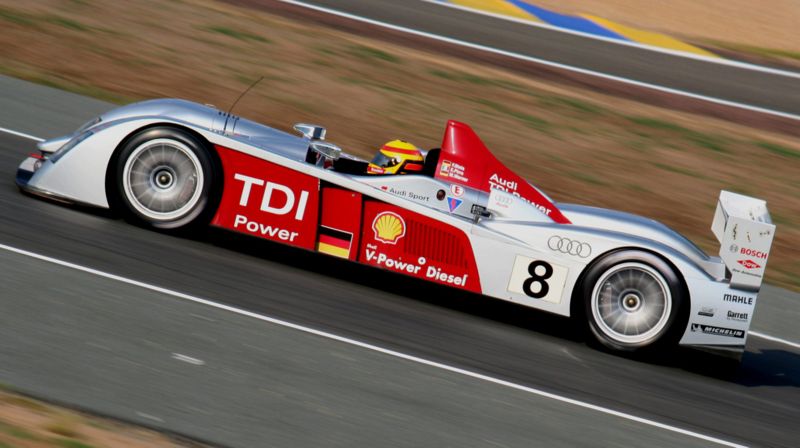
Last year Audi has dominated in North America in the American Le Mans Series in particular in the P1 class. The team could do with a race car with a diesel engine. The team was so dominant that he won all the races in their class last season. Apart from the fact that the Audi R10 diesel race car that dominated the ALMS, also won the 24 Hours of Le Mans.
if I myself prefer a peugeot 908, how about you?
The dominance of the Audi on the track is about to be challenged by Peugeot. The latter, there was a diesel Peugeot 908 HDI to test in Sebring. These tests will give fans a look at what Peugeot Audi has in store for next season.
Last year, when tested for the 24 Hours of Le Mans, Peugeot diesel car was faster than the Audi R10. But during the grueling endurance race, Audi has proved to be the best. It also came to the composers are undoubted pace in the American Le Mans Series.
Paddock Talk Zach Wenzel said that Audi used its dominant position in the last years 24 Hours of Le Mans as a standard for this year’s campaign. During the race, although the Peugeot has to be faster in the examination of the Audi R10 diesel cars beat the other ten rounds. This humiliating defeat could a fire under the French team have motor claims.
Wenzel said that the development of the 908 and its test is carried out in Sebring, to see how the R10 compared. “Even if Peugeot are not competing with Audi at Sebring, the main objective of the team 908 by Serge Saulnier’s done, a reference point on the pace of the R10 for the coming season, so winning that they can play a major battle to Wolfgang Ullrich and Audi in North America, “said Wenzel.
Both vehicles are operated with diesel fuel much in the promotion of diesel engines. In the U.S., where diesel engines could have been avoided, as Audi dominated in the American Le Mans Series with a diesel car equipped Anthony Fontanelle is a 35-year-old car buff, that’s up in the Windy City has grown. It is the independence for a car magazine when he is not busy customizing cars in his workshop.
LinkWithin


